Dealer in Rare and First-Edition Books: Western Americana; Mystery, Detective, and Espionage Fiction
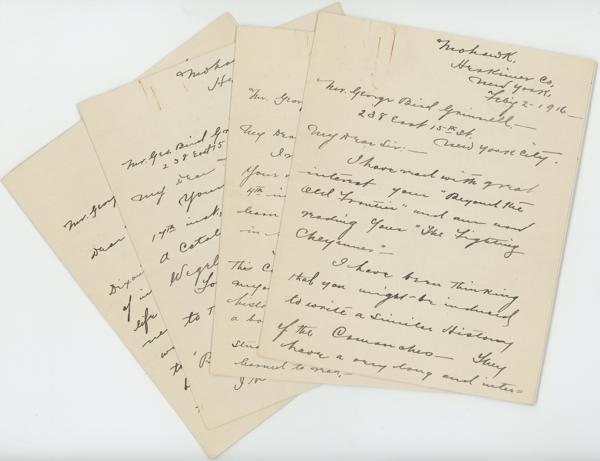
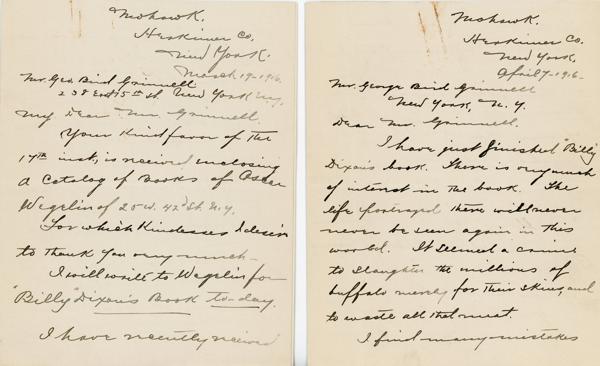
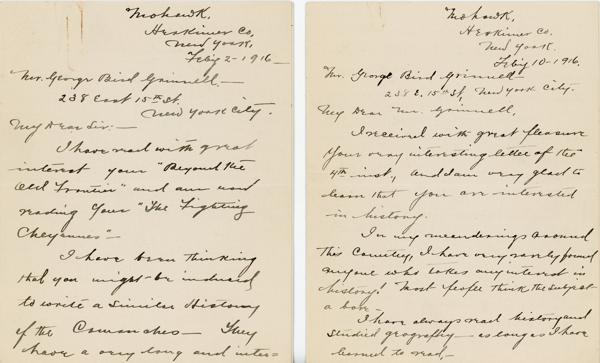
Archive Of Four Letters Written To George Bird Grinnell, The Prominent American Anthropologist, Historian, Naturalist, And Author From Frank West, The U. S. Army Cavalry Officer Who Had Been Awarded The Medal Of Honor In 1892 For His Military Action At Big Dry Wash, Arizona On July 17, 1882
FRANK WEST
Other works by FRANK WESTPublication: Frank West, Letter-writer, 1916, Mohawk, Herkimer County, New York
First edition. The archive consist of four letters written to George Bird Grinnell, the Prominent American anthropologist, historian, naturalist and author by Frank West, the United States Army cavalry officer who had been awarded the Medal of Honor in 1892 for his military action at Big Dry Wash, Arizona, on July 17, 1882. Grinnell is considered a leading authority on Plains Indians and especially so for the Cheyenne Nation. He authored two prominent books on the Cheyenne and Lieut. West acknowledges the contribution and suggests that Grinnell might be induced to write a similar history of the Comanches.
George Bird Grinnell was a graduate from Yale University receiving a B.A. in 1870 and a Ph.D. in 1880. In 1870 he obtained a position with an expedition of the Peabody Museum to collect vertebrate fossils in the West for six months. By the time that Grinnell died in 1938 he was known as an anthropologist, historian, naturalist and author relating to the Plains Indian cultures. He authored a number of books and included among them is The Fighting Cheyennes in 1915. This important work focuses on the numerous battles and wars fought against their hereditary enemies or the U.S. Military. Sand Creek, The Platte Bridge Fight, The Fetterman Massacre, The Medicine Lodge Treaty, The Beecher Island Fight, Battle of the Washita, Adobe Walls, The Battle of the Rosebud, Battle of the Little Bighorn, The Capture of Dull Knife's Village, and The Lame Deer Fight are among the many recorded here. In 1923 The Cheyenne Indians, Their History and Ways of Life was published of which J. Frank Dobie said, "This two volume work supersedes The Fighting Cheyennes, 1915. It is noble, ample, among the most select books on Plains Indians."
Frank West graduated from the United States Military Academy West Point June 14, 1872 and was assigned to the Sixth Calvary. While serving with the Sixth Cavalry he received the brevet of First Lieutenant for his services against the Cheyenne, Kiowa, and Comanche in 1874. On July 17, 1882, while in command of Troop I and a detachment of Indian scouts, he and his men moved against Apache Indians at Big Dry Wash, Arizona. The Indians occupied a strong position across a deep canon which was covered with a growth of heavy timber. Lieutenant West led his men in the advance against this position and continued the fight until sixteen Indians were killed, many wounded, and sixty horses and mules and much camp property captured, the balance of the Indians escaping in disorder. For his service on this occasion Lieutenant West received the Medal of Honor for "distinguished conduct in action against hostile Apache Indians at the Big Dry Wash, Arizona, July 17, 1882, in rallying his command and leading it to the advance against the fortified position of the enemy."
A few points of interest taken from the letters from West to Grinnell are as follows:
1). "By the way, Maj. General Hugh L. Scott was Chief of Staff told me that he had Quanah Parker's (Comanche Chief) account of that fight in writing. I think as a matter of History that account ought to be published."
2). "I was stationed at Camp Supply in the Indian Territory, from March 1873 until the summer of 1875, and was on the campaign in the Panhandle of Texas which began in July 1874 and which lasted until the Spring of 1875. That was the last war of the Comanches Kiowas and Cheyennes of the Indian Territory. There were several Regiments of Regular Troops engaged. Your Book "The Fighting Cheyennes is very brief on that Campaign."
3). "I know Gen Scott very well and am very fond of him. He is as far as I Know the only army officer that takes any interest in the Indians." "I think he could write a book on the Comanches giving the Indian version of the affairs. But, I believe there is a great deal in their history, that living Comanches have forgotten."
4). Tho I have not seen "Billy Dixon's Life" and had not heard of it until recently. I knew him on the Miles Campaign of 1874 & 5 in the Texas Panhandle. He was one of the Adobe Walls Buffalo Hunters that Gen Miles afterwards hired as Scouts." "The best frontiersman I ever knew about Indians, was Ben Clark. He was a very intelligent man, and could describe what he knew when questioned he also could describe the geography and topography of a country he had been over." "I think if Gen Scott waits about the Indian Sign language it would have to be finished by some government institution like the Smithsonian. Altho such a work would be of great value to the Student and scientist. It would not have a popular sale."
5). "I have just finished 'Billy Dixon's book. There is very much of interest in the book." " I saw Dixon during the campaign of 1874-5, but did not get acquainted with him." "We had "Callahan" Dixon's friend and some other buffalo hunters an teamsters with the Supply Train. They made great boasts as to their Indian exploits on the "Plains." But as soon as we were corralled by the Indians, They dug a cellar about 12 feet deep, and got down in the bottom of it and stayed there during all the fighting and at night they ransacked the wagons and stole all the canned goods, olives, etc., for liquid to quench their thirsts." "The assistant wagon master was a brave man and a fine shot. He was killed early in the fight."
Lieut. West is well-read and with well-researched information he points out that he has read virtually all he could find on "Western Plains history." An interesting and historically important group of letters between two men who actually experienced life in the West and some of the events involving the "Plains Indians." Very good legible and easily read letters.
Inventory Number: 54452$6,500.00