Dealer in Rare and First-Edition Books: Western Americana; Mystery, Detective, and Espionage Fiction
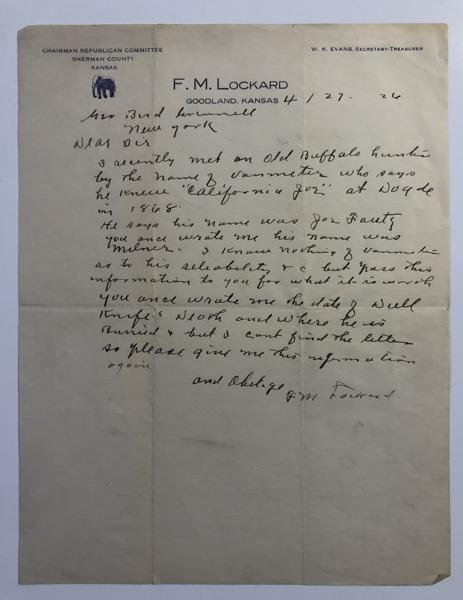
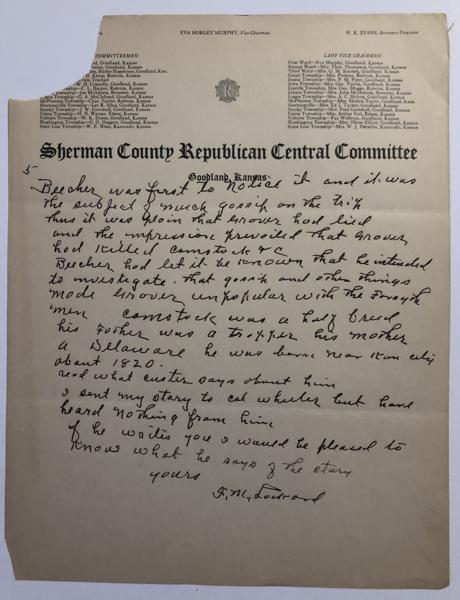
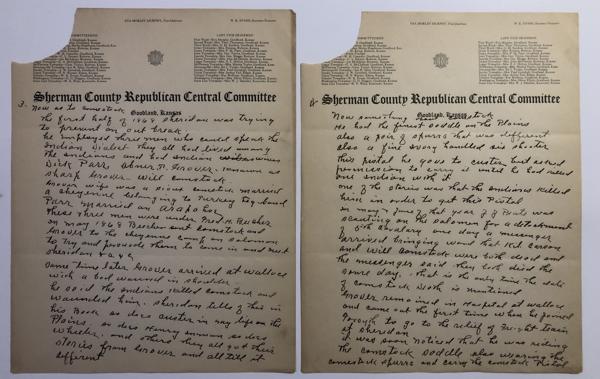
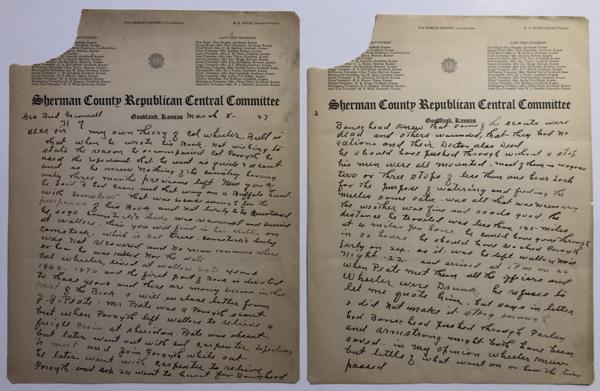
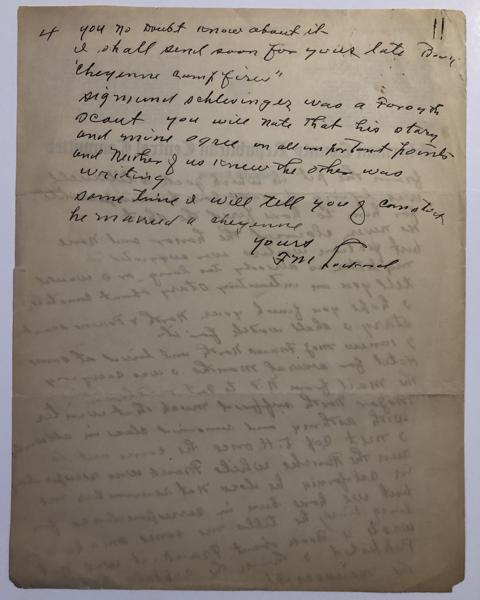
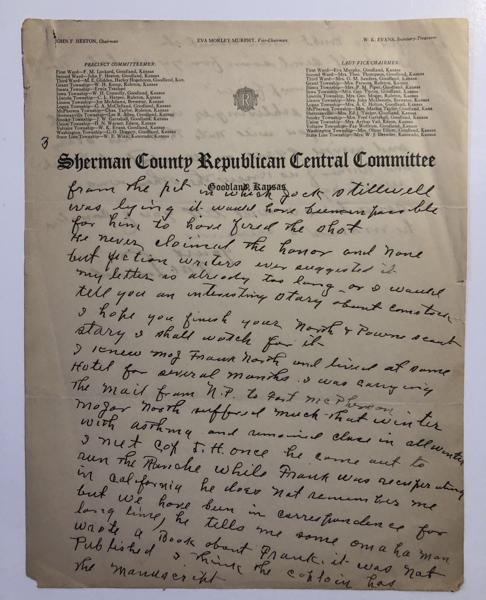
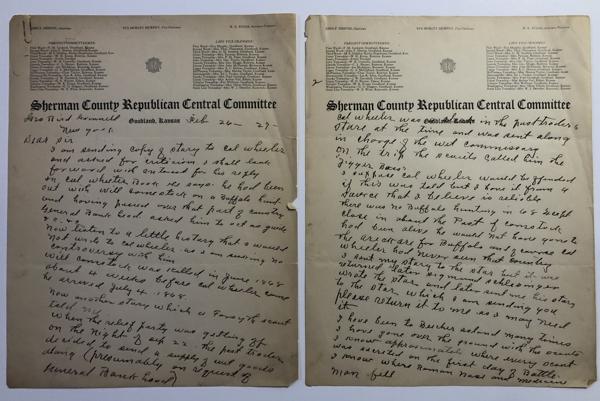
3 Manuscript Letters To Author, George Bird Grinnell, By Frank M. Lockhard, Regarding The Battle Of Beecher Island And The Indian Wars On The Plains Of Kansas In 1868
FRANK M. LOCKHARD
Other works by FRANK M. LOCKHARDPublication: 1926 & 1927, Goodland, Kansas
Three Signed Manuscript Letters. Total of 10 pages. The letters are neatly written. All are written on the letterhead of the Sherman County Republican Central Committee of Goodland, Kansas and signed F. M. Lockhard. The First Letter is a single page, 8.5" x 11", dated 4-27-1926. The Second Letter is four pages, 8.5" x 11", dated Feb. 26-1927. The Third Letter is 5 pages, 8.5" x 11", dated March 8-1927. The letters speak of several well-known officers and scouts for the military, and their involvement with the Battle of Beecher Island and other lesser known events and campaigns in western Kansas and Colorado in 1868, including Colonel Homer W. Wheeler, author and veteran of the Indian Wars; Colonel George A. Forsyth, commander of the Army and it's scouts at the Battle of Beecher Island, where he was wounded 3 times, as he and his men fought a large group of Cheyenne, Sioux, and Arapaho warriors; Lieutenant Frederick Beecher, killed during the battle; Cephas William "Dick" Parr, survivor of the battle; J. J. Peate, one of the scouts that led the rescuing troops to the beleaguered men of Beecher Island; William "Medicine Bill' Comstock, scout operating out of Fort Wallace, killed a few weeks before the battle of Beecher Island; and Abner "Sharp" Grover, long-time scout, and controversial figure among his peers. Lockhard is harsh in his comments about Colonel Homer Wheeler, "In Col. Wheeler's book he says he had been out with Will Comstock on a Buffalo hunt and having passed over that part of the country General Bankhead asked him to act as guide, etc. Now listen to a little history that I would not write to Col Wheeler, as I am seeking no controversy with him. Will Comstock was killed in June 1868 about 4 weeks before Col Wheeler came, he arrived July 4."... "he knew nothing of the country having only 3 months previous left New York. He said, 'I had been out that way on a Buffalo hunt with Comstock.' That was excuse enough for the purposes of his Book and not likely to be questioned he says Comstock's body was recovered and buried at Wallace, which is not true. Comstock's body was not recovered and no man knows where or how he was killed nor the date." Lockhard is highly critical of the slow response by General Bankhead and Colonel Wheeler, and others involved in the rescue of the men at Beecher Island: "Bankhead knew that some of the scouts were dead and others wounded, that they had no rations and their Doctor also dead. He should have pushed through without a stop his men were all mounted, most of them in wagons two or three stops of less than one hour each for the purpose of watering and feeding the mules some oats. Was all that was necessary. The weather was fine and the roads good"..."He should have reached Forsyth early on the 24, as it was he left Wallace a nice night-the 22 and arrived at 1 PM on the 26. When Peate met them all the officers and Wheeler were Drunk." A little known controversy, suggested by others, and addressed by Lockhard in these letters, is the death of Will Comstock and the role of "Sharp" Grover in his death. "In May 1868 Beecher sent Comstock and Grover to the Cheyenne camp on the Solomon to try and persuade them to come in and meet Sheridan, etc...Sometime later Grover arrived at Wallace with a bad wound in the shoulder he said the Indians killed Comstock and wounded him. Sheridan tells of this in his book so does Custer in My Life On The Plains...Now something about Comstock. He had the finest saddle on the Plains also a pair of spurs that was different. Also a fine Ivory handled six shooter...Grover remained in Hospital at Wallace and came out the first time when he joined Forsyth to go to the relief of Freight train at Sheridan(late Summer) it was soon noticed that he was riding the Comstock saddle. Also wearing the Comstock spurs and carrying the Comstock Pistol. Beecher was first to notice it and it was the subject of much gossip on the trip thus it was plain that Grover lied and the impression prevailed that Grover had killed Comstock." Controversial and uncommonly informative, F. M. Lockard's letters are significant, as they reflect the violent days of 1868, when the western plains of Kansas was subject to constant raids and deadly conflict of the U.S. Army and the united tribes of the Southern Cheyenne, Sioux, and Arapaho in 1867-1869, much of which was a reaction to Chivington"s massacre of Cheyenne Indians who believed themselves to be in a protected, compliant village, with no expectation of attack. We believe these letters represent an interesting, and significantly challenging and informative record, providing an uncommon insight into much of the inside communication and concerns of the military operations in this period in Kansas and U.S. Army history. Letters are highly legible and clean, yet somewhat fragile. Folds and some minor edgewear. Upper left corner of third letter is missing, but with no loss to text or substance of letter. Very Good.
Inventory Number: 54480$2,500.00