
Dealer in Rare and First-Edition Books: Western Americana; Mystery, Detective, and Espionage Fiction
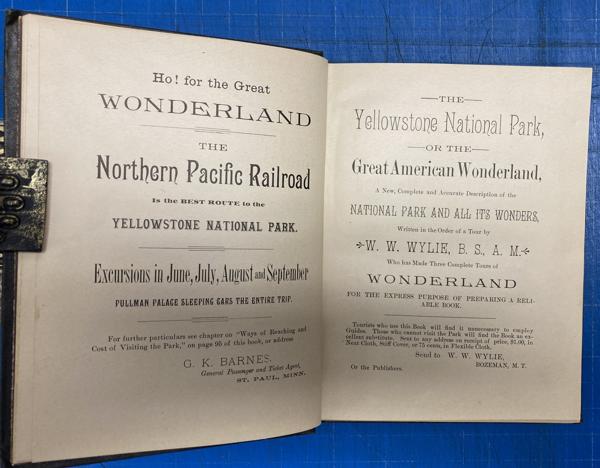
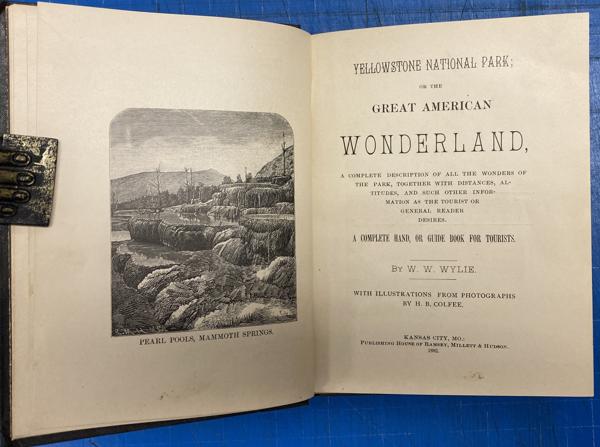
Yellowstone National Park; Or, The Great American Wonderland: A Complete Description Of All The Wonders Of The Park, Together With Distances, Altitudes, And Such Other Information As The Tourist Or General Reader Desires. A Complete Hand, Or Guide Book For Tourists
W. W. WYLIE
Other works by W. W. WYLIEPublication: Publishing House of Ramsey, Millett & Hudson, 1882, Kansas City, Missouri
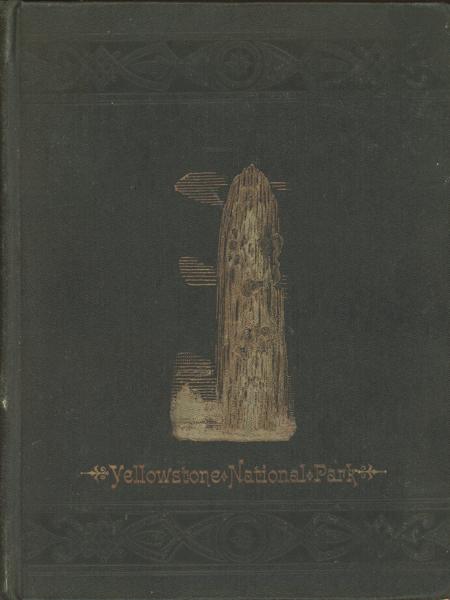
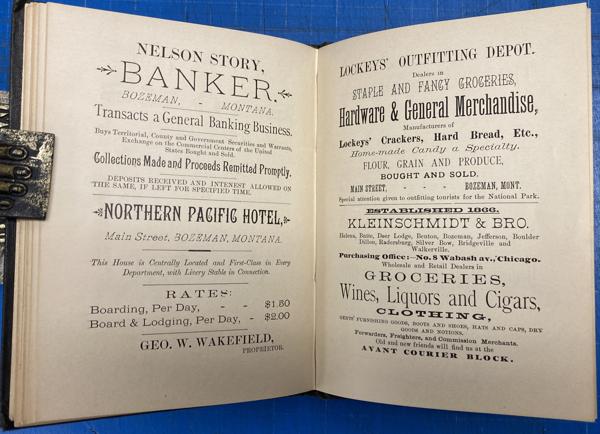
First edition. 6 3/4" x 5 1/4" in original black cloth with gilt vignette of a geyser on the cover. 99 pp. plus [12] pp. of advertisements. Inscribed by the author "Compliments of the Author." Preface. Contents. Introduction. Advertisements. "All tourists do not feel able to hire guides; and since plain roads are now Open to all points of interest, what is needed, it seemed to the author, is a real guide-book. It was during this first tour Of Wonderland that the purpose was originated to try to prepare such a book."
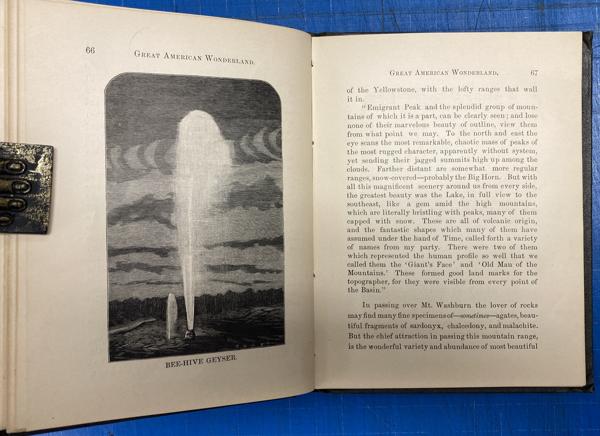
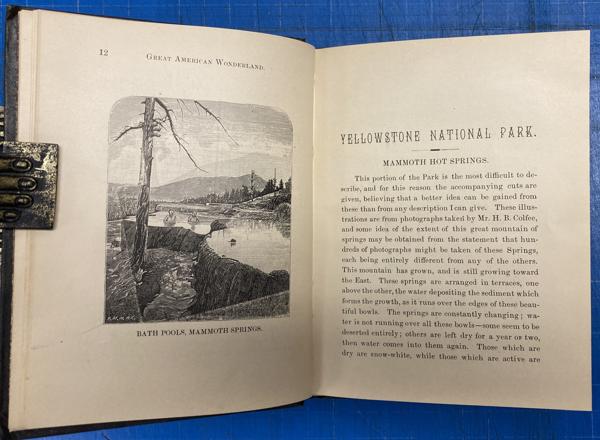
This is the rare volume of William Wallace Wylie's 1882 Yellowstone Guidebook, the first real guidebook to Yellowstone. Wylie was among the earliest promoters of commercial travel to the Park, while Henry Bird Colfee was one of the pioneering photographers of Yellowstone. Colfee's photographs provided the basis for the illustrations in this volume. In 1881–82, Wylie and Colfee also traveled together giving illustrated lectures promoting Yellowstone as a tourist destination, using projected photographs to introduce the Park to audiences beyond the region. The book thus forms part of the earliest systematic effort to make Yellowstone's scenery known to the American public and encourage tourism. Colfee supplied the photographic material while Wylie provided the narrative and promotional presentation. Information on Mammoth Hot Springs, Falls of Middle Gardner River, Willow Park, Obsidian Cliff, lake of the Woods, Norris Geyser Basin, Gibbon Meadows, Paint Pots, Blood Geyser, Gibbon Falls, the Lower Geyser Basin, Sheridan Geyser, the upper geyser basin, Old Faithful, the Castle, Devil’s Well, Bee-Hive Geyser, the Grotto, Saw-mill Geyser, Yellowstone Lake, Sulphur Mountain, the Upper and Lower Falls of Yellowstone, the Grand Canon, Crystal Falls, Mount Washburn, Petrified Forest, Hoodoo Basin, Soda Butte Springs, etc. Table of Distances. Table of Altitudes. Information on drinking geyser water, theory of the causes of geyser action, rules and regulations of the park, etc.
William Wylie established the Wylie Camping Company in Yellowstone National Park in 1883 using moveable camps. In 1896 he was allowed to establish permanent camps and lunch stations at the most interesting locations in the park. By 1905 he had camps at Riverside (near West entrance), Old Faithful, Lake, Canyon, Roosevelt, and Swan Lake. Lunch stations were at Gibbon Falls and West Thumb. Unable to compete and expand his operations, he retired after the 1905 season, and A.W. Miles continued the operation through 1916.
A near-fine copy of a scarce early guide to Yellowstone, documenting the development of tourism in the Park and the emerging American national-park movement. The National Park Service cites Wylie's 1882 guide in its publication 'Managing the "Matchless Wonders:" A History of Concession Development in Yellowstone National Park, 1872–1966.'
Inventory Number: 54731$1,750.00


