Dealer in Rare and First-Edition Books: Western Americana; Mystery, Detective, and Espionage Fiction
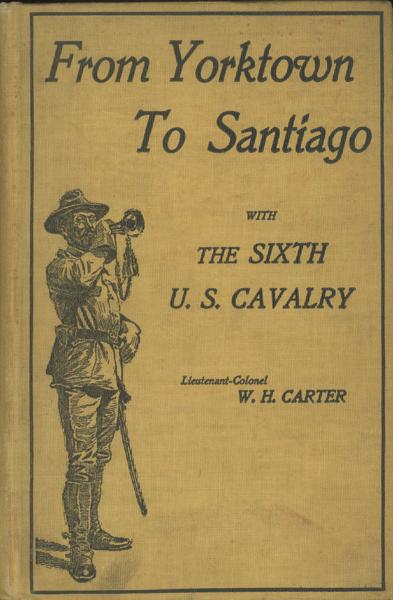
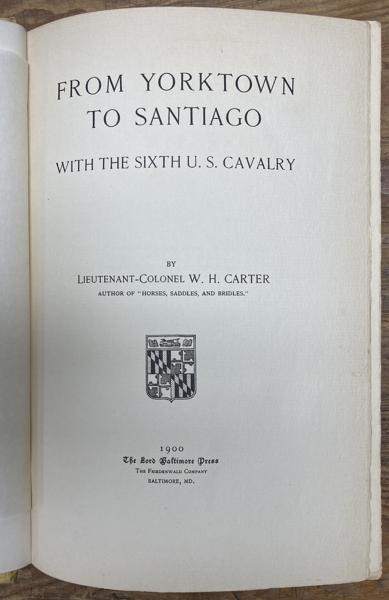
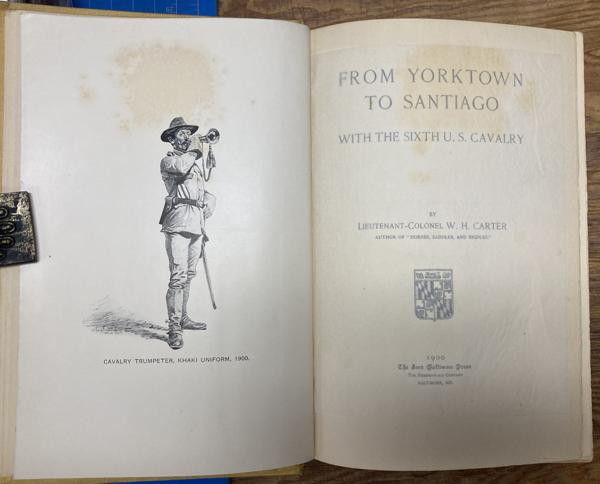

From Yorktown To Santiago, With The Sixth U.S. Cavalry.
LIEUTENANT-COLONEL W. H. CARTER
Other works by LIEUTENANT-COLONEL W. H. CARTERPublication: The Lord John Press, 1900, Baltimore
First edition. 8vo. Inked name of "A. E. Bates, Nov. 1900" on the front free fly leaf. Pictorial cloth, vii [blank], 317 pp., preface, introduction, frontispiece, illustrated, plates, teg, aftermath, index. Illustrations by Frederic Remington, Larned, Zogbaum, and others. The Sixth U.S. Cavalry had its birth during the Civil War with its first action at Yorktown, Virginia in 1862. From 1865 until 1871 the regiment was stationed in Texas protecting settlers from raids by the Comanche Indians along the frontier. After 1871 the regiment moved into Kansas and Indian Territory, and in 1874 were under the command of Col. Miles in his operations against the Comanches, Cheyennes, and Kiowas. The next ten years were spent in Arizona and New Mexico in operations against the Apaches. The last action against Indians was at Wounded Knee in 1890. In 1898 the unit operated in the Spanish-American War and distinguished itself in the battle of Santiago. A large part of the original first edition was destroyed by fire, making it one of the scarcest and most expensive histories of a major military unit.
Alfred E. Bates (July 15, 1840 – October 13, 1909) was a career officer in the United States Army. A veteran of the American Civil War, American Indian Wars, and Spanish–American War, he attained the rank of major general and was best known for his service as Paymaster-General of the United States Army from 1899 to 1904. -- Wikipedia. In 1875 Bates transferred to the Paymaster department. His active Indian War period service included Fort Dodge and Fort Wallace, Kansas in 1865 & 1866, as well as Fort McPherson in 1869. Bates was an Instructor of Cavalry tactics at West Point from 1869-1873, before returning to the frontier of Wyoming in 1873. On July 4, 1874, Captain Alfred E. Bates led 63 men of Co. B, 2nd Cavalry, 20 Shoshone scouts, a few civilians, and 300 Shoshones under the command of their Chief Washakie in an attack on a hostile camp of Arapaho Indians. The battle resulted in the capture of several hundred Arapaho horses, failed to capture the Arapaho village of over 100 lodges. Bates had 2 men killed and 6 wounded, the Shoshones had 2 killed and 3 wounded, and the Arapaho had 25 killed and at least 20 wounded. The battle was fought in central Wyoming, where Bates was stationed at Camp Brown.
Lightly sunned on the spine with covers lightly soiled and interior clean and tight. A very good copy.
$1,275.00